
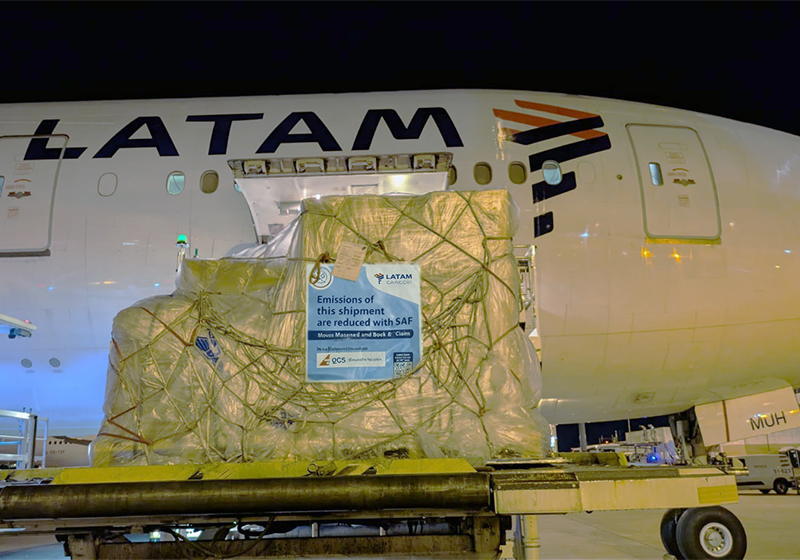
In a context where CO₂ emissions management is becoming increasingly relevant in international logistics, LATAM Cargo Group and Quick Cargo Service have entered into an agreement to incorporate Sustainable Aviation Fuel (SAF) into their operations between Frankfurt and São Paulo through the Book and Claim methodology during the 2025–2026 winter season, running from late October through March.
The initiative involves the allocation of more than 24,000 liters of SAF by LATAM Cargo Group, with the associated environmental attributes credited to Quick Cargo Service’s operation under the Book and Claim model. Through this mechanism, a lifecycle emissions reduction of approximately 55.8 metric tons of CO₂e is projected, of which 46 tons of CO2e are flight-related emissions, representing close to 7% of the emissions generated by that operation over the 21-week season.
“This agreement with Quick Cargo Service demonstrates that decarbonization is not an individual effort, but a shared commitment: when we work alongside our customers to reduce carbon intensity, we accelerate tangible and measurable transformation across the logistics value chain,” said Cristina Oñate, Vice President of Sustainability and Product at LATAM Cargo Group.
For its part, Patrick Eberhard, Head of Product Management LATAM at Quick Cargo said “strong partnerships drive meaningful change. Quick Cargo Service GmbH is proud to work closely with Latam Cargo in supporting the development and use of Sustainable Aviation Fuel. Initiatives like this demonstrate how collaboration across the air cargo value chain can help reduce emissions and move our industry toward a more sustainable future”.
This agreement forms part of LATAM Cargo Group’s broader strategy to develop solutions that enable customers to integrate climate management tools into their air cargo operations. Collaboration between airlines and customers continues to consolidate as a key enabler for progressively advancing the decarbonization of air cargo transportation on trade lanes to and from South America, contributing to the long-term objective of achieving net-zero emissions by 2050.