

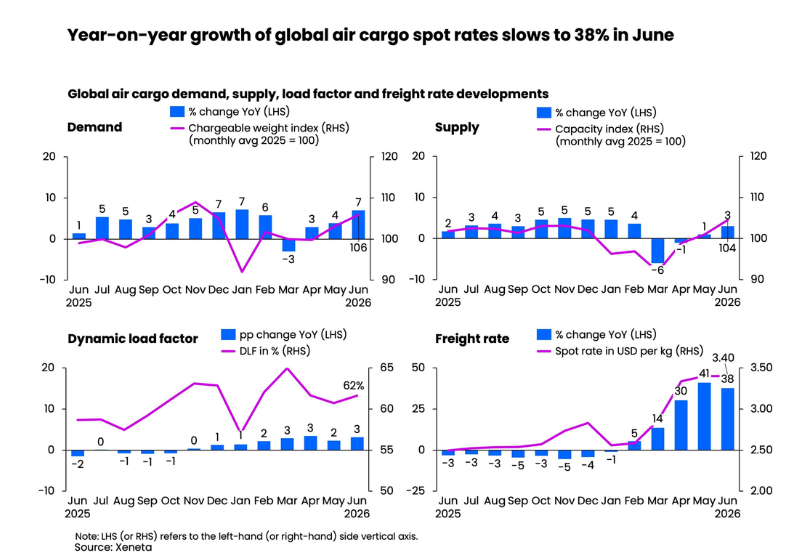
Global air cargo spot rates increased 38% year-on-year to an average of USD 3.40 per kg in June, according to Xeneta, although the pace of growth eased from 41% in May, indicating that pricing pressures are beginning to stabilize.
Despite the slowdown in rate growth, global air cargo demand remained resilient, rising 7% year-on-year in June, significantly outpacing the 3% increase in available capacity. Xeneta attributed the continued strength primarily to booming artificial intelligence (AI)-related shipments, particularly on the Asia Pacific–North America trade lanes, which are offsetting the decline in e-commerce volumes.
Xeneta's Chief Airfreight Officer, Niall van de Wouw, said AI has become the key driver of air cargo growth despite accounting for less than 10% of total air cargo volumes. He highlighted that global semiconductor sales surged 106% year-on-year in April, while Taiwan recorded its fastest quarterly GDP growth in nearly five decades, underlining the growing influence of AI and semiconductor exports on air freight demand.
The impact is reflected in freight rates, with Northeast Asia–North America and Southeast Asia–North America corridors witnessing rate increases of 41% and 42%, respectively, compared to late February. Meanwhile, rates on Middle East routes, which had spiked due to regional conflict, are beginning to ease as additional capacity returns to the market.
Xeneta also noted that the transatlantic market experienced a 25% decline in rates from Europe to North America following the return of summer passenger schedules, which added significant belly cargo capacity.
On the demand side, the market remains robust, with the dynamic load factor rising to 62%, up three percentage points from a year earlier, reflecting continued strong cargo utilization.
While AI-related shipments continue to support the market, e-commerce volumes remain under pressure. China's low-value and e-commerce exports declined 7% year-on-year in May, marking the sixth consecutive monthly drop. The trend is expected to continue as new regulations, including the European Union's removal of its €150 de minimis exemption, reshape cross-border e-commerce flows.
Looking ahead, Xeneta observed that uncertainty has prompted shippers to rely increasingly on short-term contracts. In the second quarter of 2026, 58% of newly signed shipper-forwarder contracts were for three months or less, while nearly half of all chargeable air cargo volumes moved on spot market rates, reflecting continued caution over market direction. Despite current rate levels, Xeneta expects the broader trend in air freight pricing to gradually move downward as market conditions stabilize.