According to the latest weekly figures from WorldACD Market Data, chargeable weight in week 17 (20 to 26 April) from Central & South America (CSA) recorded a +19%, week-on-week (WoW) increase, as flower exports from key countries such as Colombia and Ecuador were shipped to the US and Canada ahead of Mother’s Day on 10 May. That +19% WoW rise is identical to the growth of that market in the equivalent week last year. The other significant WoW tonnage rise in week 17 this year was a +3% WoW increase from Asia Pacific, boosted by shipments ahead of Labor Day holidays in China and various other countries on or around 1 May, which in China extend across several days. Tonnages from the Middle East & South Asia (MESA) region saw a small (+1%) WoW increase in week 17, while volumes from Europe and Africa were flat, and there was a -2% drop in volumes from North America origins.
Those changes helped drive worldwide tonnages +9% higher than in the equivalent week last year, including +8% year-on-year (YoY) growth from Asia Pacific markets, and strong YoY rises from Europe (+20%) and CSA (+12%), despite the continuing challenges faced by international markets due to the conflict in the Middle East. But tonnages from MESA (-3%) and Africa (-8%) were down, YoY, in the face of ongoing capacity and other challenges.
On the capacity side, the buoyant flower trade led to a +8% WoW increase in capacity from CSA markets in week 17 this year, while elsewhere there were WoW increases in capacity from Europe (+5%) and a further +3% increase in capacity from the Middle East & South Asia (MESA) region, +2% from North America, and a marginal +1% rise from Asia Pacific.
However, compared with global air cargo capacity in week 7, prior to the US and Israel attacking Iran, global capacity in week 17 was down by -3%, with MESA capacity down by -26% compared with pre-war levels – and, more specifically, for the Gulf capacity was at -46%, and the Levant -20%.
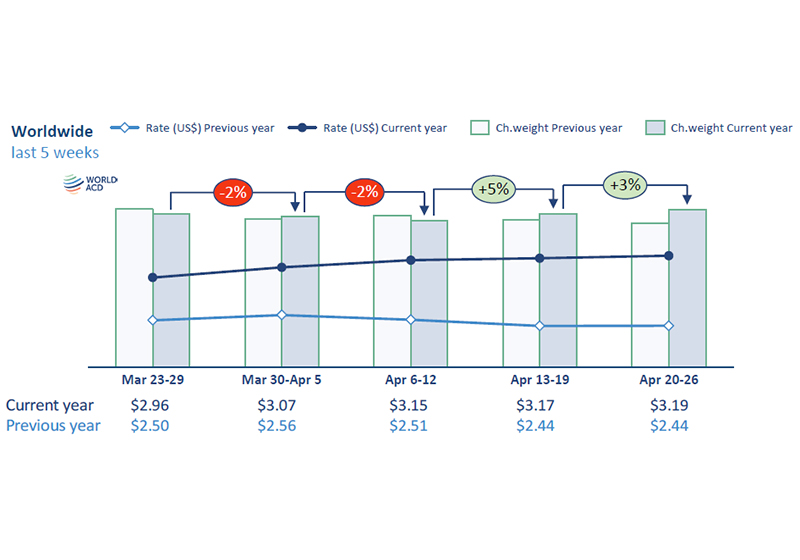
These ongoing capacity challenges, combined with rising jet fuel costs and availability issues, mean that air cargo pricing remains significantly above pre-war levels and the levels this time last year, although rates were relatively stable in week 17, with average WoW rises of +2% in global spot rates (to US$3.76 per kilo) and +1% in full-market rates (to US$3.19 per kilo), including a mix of spot rates and contract prices. That means global full-market rates are up +30%, YoY, and spot rates are around +45% higher than this time last year, including big YoY increases from MESA (+65% to $4.65), North America (+60%, to $2.65), Asia Pacific (+41%, to $5.11), Africa (+40%, to $2.86) and Europe (+32%, to $2.87). CSA spot pricing is up by a relatively modest +12%, YoY, averaging $1.92 per kilo, based on the more than 500,000 weekly transactions covered by WorldACD’s data.
Although average MESA to Europe spot prices dropped somewhat in week 17 (-6%, WoW), including falling rates from all the region’s main origin markets, they remain hugely elevated (+73%) compared with this time last year, because of the continuing disruptions to capacity and operations. Those elevated spot rates range from a +55% YoY increase from Bangladesh ($5.15 per kilo), whereas rates from Dubai averaging $4.68 per kilo are up by around +160% compared with this time last year.
MESA to US spot rates in week 17 were around +64% higher than this time last year, including India to US rates averaging $7.15 per kilo (+60%, YoY), while Dubai to US spot rates averaged above $9 per kilo, up more than +160%, YoY.
Forwarders indicate that demand for capacity from China to the US remained strong last week, driven by AI server shipments, e-commerce activity, ocean-to-air cargo conversions, and general cargo, driving sustained capacity pressure and maintaining elevated rates. The pressure on capacity was expected to soften during China’s Labor Day holiday period, while demand to Europe has been stabilizing, with rates expected to follow. However, forwarders report continuing high demand and tight capacity from most Asia Pacific markets that is expected to remain, along with associated high pricing and extended lead times.
As mentioned, rates have continued to rise, albeit at a slower pace than in the initial weeks after the start of the conflict in the Middle East. However, the closure again of the Strait of Hormuz, further increases in fuel prices, and no end in sight to the confrontation, mean we may expect continuing high air cargo spot rates, and further increases in the coming weeks linked to the costs and availability of jet fuel.