DHL Group is strengthening its Life Sciences and Healthcare capabilities in Singapore through a series of investments aimed at expanding its capacity to transport, store and distribute pharmaceuticals, medical devices, clinical trial materials and other healthcare products across the Asia Pacific region.
The investments build on the launch of DHL’s Pharma Hub in Singapore last year and focus on three key areas: specialised infrastructure, healthcare expertise and strategic partnerships. Together, these initiatives are designed to support the growing complexity of healthcare supply chains while maintaining product integrity, regulatory compliance and temperature control throughout the logistics journey.
Asia Pacific’s pharmaceutical logistics market is expected to grow from US$163 billion in 2025 to nearly US$239 billion by 2031, driven in part by increasing demand for biologics, vaccines and other temperature-sensitive products. In response, DHL is expanding healthcare infrastructure across its Express, Global Forwarding and Supply Chain businesses, while continuing to strengthen its specialised Life Sciences and Healthcare capabilities.
A major investment is the new DHL Singapore Coldchain Hub, which will be operated by DHL Global Forwarding. Located within Changi Airport’s 24/7 Free Trade Zone at Changi Nexus One, the S$22 million (€15 million) facility will provide 3,047 sqm of GDP-aligned, temperature-controlled infrastructure for high-value and temperature-sensitive healthcare cargo. The facility will offer dedicated 2°C to 8°C and 15°C to 25°C handling environments and is expected to launch in late 2027. The hub will form part of DHL’s broader Health Logistics Air Freight Network, connecting major pharmaceutical and life sciences markets worldwide.
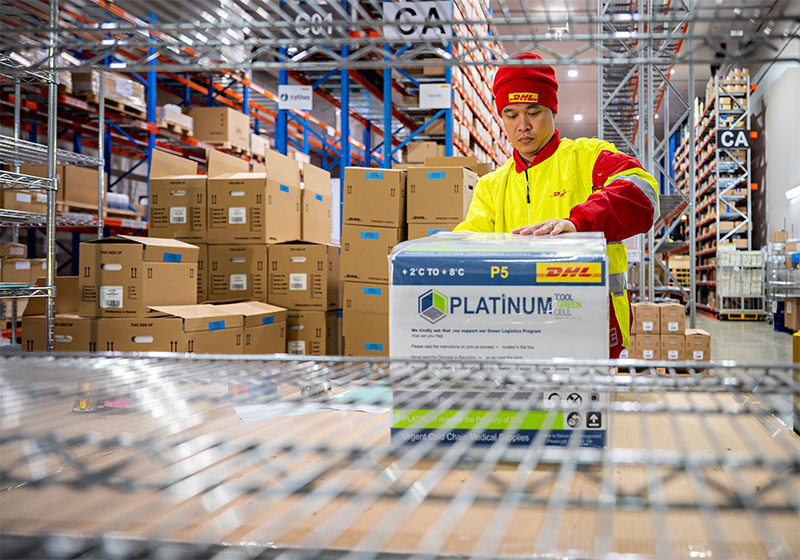
DHL Supply Chain is also expanding its healthcare footprint with Pharma Hub 2, a S$7 million (€5 million) facility spanning more than 8,000 sqm. The 15°C to 25°C temperature-controlled facility will provide approximately 7,680 pallet positions and support warehousing, distribution, kitting and other value-added healthcare logistics services. Once operational, expected in the first half of 2027, DHL Supply Chain’s total pharmaceutical logistics footprint in Singapore will reach approximately 16,000 sqm and 12,000 pallet positions.
Meanwhile, DHL Express has introduced a 20 sqm GDP-compliant handling and storage area at its South Asia Hub at Changi Airport. Operating at 15°C to 25°C, the facility enables temperature-sensitive pharmaceutical shipments to move securely through the regional air logistics gateway and represents the first GDP-compliant healthcare logistics space within a DHL Express facility globally.
Beyond infrastructure, DHL is investing in specialist expertise. Teams across Express, Global Forwarding and Supply Chain are receiving ongoing training in temperature-controlled handling, GDP requirements, quality management and regulatory compliance through programmes including DHL’s Certified Life Sciences Specialist initiative. The company is also expanding its pool of healthcare specialists, including pharmacists, to support increasingly stringent supply chain requirements.
DHL is further strengthening Singapore’s healthcare logistics ecosystem through partnerships with airlines, airport operators, healthcare manufacturers and logistics providers. Its collaboration with Changi Airport Group is focused on enhancing healthcare trade lanes across Asia Pacific, while a partnership between DHL Express and Life Science Incubator (LSI) will provide start-ups, SMEs, researchers and healthcare innovators with access to logistics expertise, training and support covering international trade, supply chain management and cross-border regulatory requirements.
The investments form part of DHL Group’s broader commitment to Life Sciences and Healthcare, including €500 million earmarked for Asia Pacific as part of its €2 billion global investment in the sector announced in 2025. Through expanded infrastructure, specialised expertise and strategic partnerships, DHL aims to reinforce Singapore’s position as a key gateway for healthcare and life sciences supply chains across Asia Pacific while helping customers move critical products safely, reliably and compliantly.